

Curved Glass for Thermal and Acoustic Performance
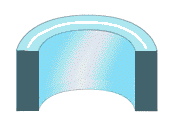
Insulating glass units consist of two lites of monolithic glass, one lite of monolithic/one laminated, or two lites of laminated glass on either side of sealed air space. Skylight glazing is typically construction with an outboard tempered or heat-strengthened lite of glass and an inboard laminated glass lite. The laminated glass lite provides overhead safety from falling glass if breakage should occur. Acoustical units may have one or both laminated glass lites for sound attenuation.
Silcone Spacer Types
A thermoset, silicone spacer with integral desiccant is used. According to Quanex, the supplier,
this spacer provides a unique triple seal design which incorporates an inner acrylic adhesive
seal for immediate unit handling, a polyisobutylene primary seal for enhanced gas retention
and low moisture vapor transmission, and an outer silicone seal for proven structural strength
and superior durability.
Performance Standards
| Standard | Type |
|---|---|
| ASTM E2188-19 | Standard Test Method for Insulating Glass Unit Performance |
| ASTM E2189-19 | Standard Test Method for Testing Resistance to Fogging in Insulating Glass Units |
| ASTM E2190-19 | Specification for Insulating Glass Unit Performance |
Bent insulating glass, also known as curved insulating glass, consists of two or more curved glass lites assembled into a sealed insulating glass unit (IGU). These units are designed to improve thermal performance, reduce sound transmission, and support safety requirements in architectural applications.
Bent insulating glass is commonly used in skylights, façades, curtain walls, and other custom glazing systems where both curvature and performance are required.
Configuration of Bent Insulating Glass Units
Bent insulating glass units are fabricated using a minimum of two curved glass layers, which may be monolithic or laminated, depending on the performance and safety requirements of the project. These layers are assembled with a sealed airspace between them to improve thermal insulation and overall unit performance.
Laminated glass may be specified within the insulating unit when additional safety, impact resistance, or acoustic control is required. The final configuration is determined based on the application, building code requirements, and project-specific performance goals.
Benefits of Bent Insulating Glass
Improved Safety
Laminated glass configurations can help reduce the risk of falling glass in overhead or elevated installations.
Thermal Performance
The sealed airspace within an insulating glass unit improves resistance to heat transfer, contributing to energy efficiency.
Acoustic Control
Laminated glass and multi-layer assemblies can help reduce sound transmission in noise-sensitive environments.
Design Flexibility
Curved insulating glass supports complex architectural designs while maintaining performance requirements.
Spacer and Sealing Systems
Bent insulating glass units use high-performance spacer systems with integrated desiccants to maintain internal dryness and long-term durability. Multi-seal designs are commonly employed to help manage moisture, temperature changes, and environmental exposure.
Spacer and seal configurations may vary depending on project requirements, glass dimensions, and performance criteria.
Performance Standards for Bent Insulating Glass
Bent insulating glass units are fabricated to meet applicable industry testing and performance standards for insulating glass, including ASTM standards addressing durability, moisture resistance, and long-term performance.
Compliance with these standards helps ensure consistent quality and reliability in demanding architectural applications.
Bent Insulating Glass for Architectural Projects
Bent insulating glass provides architects and designers with a solution that combines curvature, thermal efficiency, and acoustic performance. Each project is evaluated to determine the appropriate glass configuration, ensuring the finished unit meets both aesthetic goals and performance requirements.